The grouping must put its plans and defences in place to deal with the impacts of climate change.
By Simon Tay and Aaron Choo
For The Straits Times
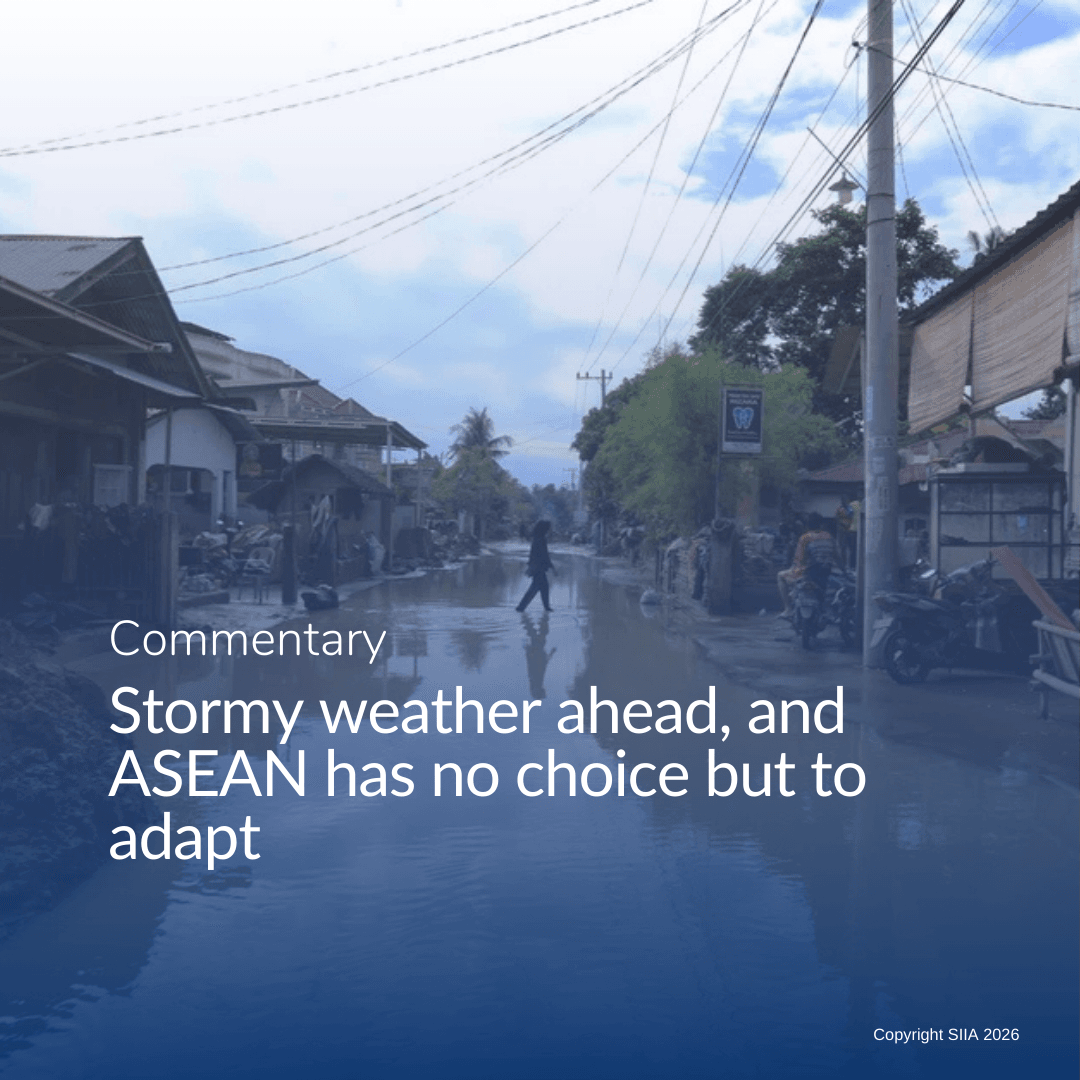
Severe storms and intense flooding have hit our region. Across Indonesia, the Philippines, Vietnam, and states in Malaysia and southern Thailand, streets and many homes are now underwater, with many thousands displaced. National governments must respond urgently and effectively to these situations of human tragedy, or risk public outrage.
Yet, while the horror of the disaster is immediate, the tragic situation also connects to what might otherwise seem faraway concerns for the future. They bring into focus the COP30 international climate meeting recently concluded on the other side of the planet, in Belem, Brazil. The dangers of climate impacts are real and present, and point to a future in which natural disasters can be worse and more frequent.
These connections underscore how global concerns must be addressed by concrete actions that states need to take, individually and in concert with neighbours. They also point to an aspect of the COP30 that has received relatively less attention.
It is something that ASEAN should take note of, as it needs to put infrastructure in place to tackle climate change, coordinate policies and raise funds – or risk seeing the economies of many of its members devastated.
National Adaptation Plans
Many headlines about the outcome of the COP30 negotiations were negative. There is a reason for this as efforts to reduce emissions and phase out fossil fuels are trailing targets. While scientific evidence shows the need for urgent climate action, political resolve is faltering, with the US and major oil-producing countries pushing back against stronger commitments.
Reporting efforts to reduce emissions, too, seem stalled. Some 78 out of the 198 parties under the UN Framework Convention on Climate Change have yet to update their pledges.
The COP30’s new Global Implementation Accelerator will need to help states in their plans to mitigate carbon emissions and move towards net-zero.
And yet, COP30 offered hope for positive developments with a new emphasis on adaptation. As compared with mitigation – which involves tackling the root causes of climate change, such as by trying to reduce greenhouse emissions – adjusting to the impacts of global warming, or adaptation, is a new imperative.
This recognises that humanity is increasingly unlikely to avoid widespread damage to planetary ecosystems. Global warming has already exceeded the key 1.5 deg C threshold – the goal of limiting global warming to 1.5 deg C above pre-industrial levels. And if 2024 was the warmest year on record, this year is on track to be the second or third hottest.
Given these facts, while mitigation continues to be important, it is essential to move ahead with National Adaptation Plans (NAPs) to prepare and best adjust to the projected and potential climate impacts.
First formalised at COP16 and COP17, these NAPs are only now gaining traction. The pledge made at COP30 to increase finance for adaptation by 300 per cent is, therefore, welcome.
Adaptation efforts are highly relevant for our region, as the current extreme weather and floodings remind us. There are large populations in low-lying and coastal lands that are exposed to extreme weather events. Key sectors face dislocation and these can impact food security, livelihoods and health.
A 2021 study by scientists from Nanyang Technological University and the University of Glasgow warned that, by 2050, climate impacts could cost the regional economy over 35 per cent of gross domestic product, unless ASEAN increases its resilience.
Singapore is developing its first NAP and this will involve public engagement over the next five years, consolidating efforts to protect urban liveability, public health and infrastructure, including water and food systems.
At COP30, Minister for Sustainability and the Environment Grace Fu highlighted Singapore’s coastal defence work and our new National Heatwave Response Plan.
Most ASEAN members have also come up with their own NAPs. However, the scope and depth of these plans vary, as do the governments’ readiness to implement them. Even as individual countries move ahead, adaptation will require international and regional cooperation.
Regional cooperation
Climate impacts on the region are already evident. This year, the Philippines alone has experienced 22 typhoons, with more expected as the monsoon season continues. Storms and floods in 2025 may have caused over US$10 billion (S$13 billion) in economic damage in the Philippines, nearly three times what the World Bank calculates as the cost to the country from such disasters in an average year.
Other damage estimates from this year’s storms include US$4.3 billion for Thailand, US$3.4 billion for Indonesia, and US$3.2 billion for Vietnam, taking into account lost earnings.
These countries need to invest in climate adaptation or brace for worse crises ahead. But unfortunately, many of the region’s most vulnerable members are also relatively less equipped to make such investments. They will need help.
The regional grouping of ASEAN does have existing mechanisms such as the ASEAN Agreement on Disaster Management and Emergency Response and the Southeast Asia Disaster Risk Insurance Facility. However, these are designed mainly for post-disaster response.
Efforts to proactively plan and implement climate-resilience adaptation are still emerging. After all, ASEAN members have only jointly issued statements at climate summits for just over a decade and are relatively new to integrating efforts in this area.
There are now calls to coordinate regional adaptation, especially for transboundary risks such as forest fires, haze, coastal erosion, and climate impacts on food supply chains. ASEAN also needs to encourage private-sector adaptation including climate-resilient infrastructure for better water management, improved agriculture, flood and sea-level defences, and stronger early warning systems.
At COP30, the group called for stronger global and regional adaptation efforts and showcased its efforts at the first ASEAN pavilion. These steps signal a commitment to taking on ASEAN multilateral climate action as a group. This demonstration of regional leadership is moreover reinforced by international partners like the European Union and can mobilise private-sector financing.
Think-tanks including the Singapore Institute of International Affairs are working on an ASEAN Climate Change Strategic Action Plan. Recommendations under consideration include a regional adaptation fund or dedicated financing facility. It will be important for ASEAN governments to formally acknowledge and estimate the cost for adaptation.
The latest estimates from the UN Environment Programme ahead of COP30 suggest that developing countries worldwide need around US$310 billion to US$365 billion per year by 2035 for their climate adaptation needs. East Asia and the Pacific account for the largest share of that estimate – some US$140 billion, much of which would be in ASEAN, given the region’s vulnerabilities.
Country-level estimates are emerging but vary considerably, as many official targets are not confined solely to adaptation and are framed as total funding needed to achieve the country’s goals across adaptation and mitigation.
Indonesia’s Ministry of Finance estimates a total US$287 billion of investment is needed to achieve Indonesia’s 2030 targets, but less than 10 per cent of this has been raised as at 2023. For Vietnam, the government believes some US$55 billion to US$92 billion is required for adaptation alone under its NAP for 2021 to 2030.
More must be done, and efforts to strengthen adaptation will not only assist environmental protection but also economic growth.
Putting adaptation infrastructure in place
However, current efforts are often piecemeal and reactive to disasters. They are also hampered by lack of consistent adaptation policies and weak regulatory and institutional frameworks.
Consider the ASEAN Power Grid (APG), which can support mitigation and resilience by enabling cross-border trade in low-carbon electricity. To date, most interconnections in the APG are land-based, such as the Laos-Thailand-Malaysia-Singapore Power Integration Project. ASEAN energy ministers have now endorsed new terms of reference for submarine cable development, addressing the more complex challenge of undersea connectivity.
Financial support is growing too. The World Bank and Asian Development Bank have introduced the APG Financing Initiative to improve the bankability of cross-border power projects.
But there are potential pitfalls. Take Vietnam’s renewable energy efforts that saw an initial surge between 2018 and 2021 driven by generous feed-in tariffs (FITs). But since 2023, when Vietnam retroactively declared that many projects had not been properly certified and would not receive the original FIT rates, the expectations of investors have been upended. Some have been pulling out, given the risk of heavy losses and bankruptcy.
The situation highlights the importance of regulatory stability for large-scale infrastructure development needed for adaptation. Adapting for climate change is not merely an environmental policy but fundamentally one that involves economic and social policies.
This year’s floods, typhoons, droughts and wildfires show this. Even as the need of the hour is to respond to the disaster, ASEAN also needs to move forward with adaptation to strengthen climate resilience.
This involves more than physical infrastructure. ASEAN must also strengthen the “software” – regulatory frameworks, information-sharing, and confidence-building mechanisms that help investors commit long-term.
National governments will lead on laws and policies, but working together, ASEAN can play a vital role in harmonising standards, sharing best practices and coordinating regional action. There is a need for new and innovative financing mechanisms – blended finance, public-private partnerships, regional climate funds. Such efforts will lay the foundation for a climate-resilient and sustainable future for the region as a whole.
Otherwise, the current gaps in attention and finance for adaptation will grow, and even valiant reactions to current disasters will be dwarfed as climate risks intensify across the region.
Simon Tay is chairman and Aaron Choo is senior assistant director at the Singapore Institute of International Affairs (SIIA). The article was originally published in The Straits Times on 4 December 2025.
Source: The Straits Times © SPH Media Limited. Permission required for reproduction