What lies ahead for the conflict in the Middle East? How is this affecting Southeast Asia? To answer these questions, the Singapore Institute of International Affairs (SIIA) held a talk on 27 March 2026 on “US-Israel-Iran: Implications for Geopolitics, International Law, and the Global Economy”, co-organised with the Middle East Institute (MEI).
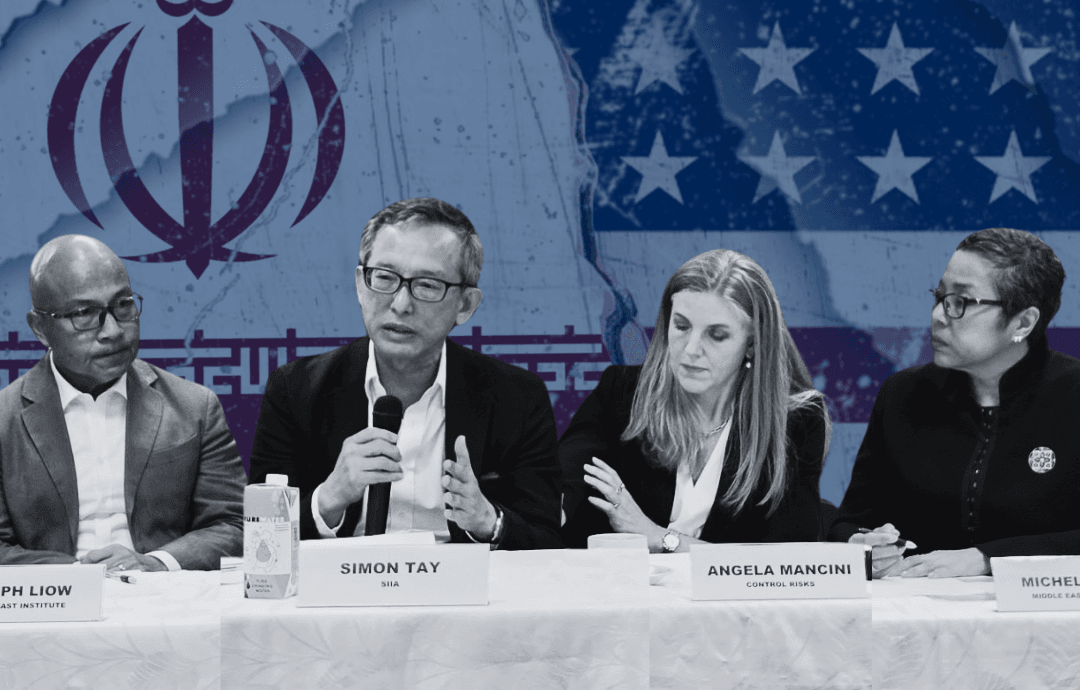
The talk featured perspectives from Professor Joseph Liow, Chairman, MEI, Mr. Simon Tay, Chairman, SIIA, and Ms. Angela Mancini, Partner and Head of Geopolitical Risk Analysis (APAC), Control Risks. The session was moderated by Ms. Michelle Teo, Executive Director of MEI, NUS.
Escalation with no clear end
“The United States and Iran are actually aligned on one thing. Both want the war to end,” said Professor Liow. “The problem is that the terms on which they want it to end are worlds apart. Because of that gap, the more likely scenario in the near term is not de-escalation, but further intensification.”
At the same time, the US faces constraints in shaping the conflict’s trajectory. Prof Liow pointed to “mission creep” and the absence of clearly defined objectives. The lack of a clear exit strategy further complicates the US’s position, raising the likelihood of prolonged engagement or an unstructured withdrawal.
Domestic political dynamics within the US introduce additional uncertainty. There are early signs of declining approval ratings and divisions, even within Trump’s MAGA, but it remains unclear how far these pressures will affect decision-making in the Republican Party and Congress.
While US politicians have talked about regime change, there is little indication that this is achievable in the near term. There is no unified opposition in Iran, no clear fracture among the country’s political elites, and state institutions remain intact and able to replenish leadership. Iran is unlikely to collapse. The removal of Iran’s top-tier leadership has instead produced a more hardened second tier, reinforcing regime cohesion and strengthening nationalist sentiment.
In the past, Iran was likely pursuing nuclear threshold capability, coming close to building a weapon without crossing the line. Now Iran has stronger incentives to move towards a full nuclear deterrent.
Israel’s goals are also different from those of the US. Prof Liow said Israel is prepared for a prolonged campaign and as increasingly views the conflict as a strategic opportunity to resolve the “Iran issue”. Israel wishes to degrade Iran’s capabilities to the point where it no longer poses a credible threat. Even if the US were to scale back its involvement, the conflict would likely continue.
Energy costs and business implications
Businesses are focused on how far the conflict will escalate and what this means for energy costs. Ms. Mancini said there are two possible escalations. The US could deepen its military involvement, and the Iranian-backed Houthi group in Yemen could blockade the Bab al-Mandeb strait, another key waterway in the Middle East, further damaging global sea trade.
“Questions around whether the United States will deepen its involvement, or whether the Houthis could further disrupt the Red Sea and force shipping around the Cape of Good Hope, are critical,” Ms. Mancini said. “Even at this stage, the expectation is already for sustained pressure on global supply chains and energy prices.”
Currently, business planning remains short-term, with firms adjusting operations rather than committing to longer-term investments. LNG prices are rising, with knock-on effects across sectors such as manufacturing and agriculture.
Wider geopolitical implications
The conflict and current geopolitical dynamics are beginning to reshape trade patterns. Firms are already reassessing supply chains as existing trade corridors become less reliable. New trade alignments are emerging, for instance with Canada pursuing closer trade links with China and India amid frictions with the US. This raises a broader question of whether diversification could extend beyond trade into security relationships, so long as the US is perceived as unpredictable.
Within the Middle East, there are also questions on whether the Gulf states will break ranks with the US in response to Iranian missile attacks or reinforce their security ties with Washington.
China has avoided direct involvement in the Middle East conflict while calling for de-escalation, balancing its limited strategic ties with Iran against far more significant economic relationships with Gulf states and the US. To some extent, China may benefit geopolitically from the US being distracted by the Middle East.
In addition, from a business perspective, China is now increasingly being seen as a relatively stable environment compared to other countries and regions. There is evidence that capital is moving from the Gulf to Hong Kong. While “China plus one” strategies adopted by MNCs remain in place, this seems to be slowing down. There is renewed confidence in China’s domestic economy, particularly in tech sectors.
Audience members at the event asked if Israel may push for a conflict with Turkey, as some academics in the US have suggested. After Iran, Turkey is Israel’s next major regional opponent. However, the panellists thought this was unlikely. Israel is unlikely to make such moves while the Iran conflict is still ongoing, and Turkey’s position as a NATO member is an additional deterrent against escalation.
Impact on Singapore and ASEAN
The disruption in maritime shipping caused by the Middle East conflict is already affecting Southeast Asia, not just in terms of fuel supply but also in price stability, straining the budgets of countries that maintain fossil fuel subsidies.
Singapore’s energy resilience is supported by diversified sources beyond seaborne shipments, including pipeline gas. This means Singapore will not be as heavily affected by supply disruptions, but Singapore remains exposed to soaring fuel prices. Unfortunately, the world may be facing a structural shift in energy prices that could last for years, rather than a short-term disruption.
Commenting on the implications for international law arising from the conflict, SIIA Chairman Simon Tay noted that conventions on the use of force and self-defence have not meaningfully constrained the behaviour of actors in the current conflict. However, it is still important for other countries to uphold these standards. The ASEAN Foreign Ministers have issued two statements on the conflict, one on 4 March, and one on 13 March following a special emergency meeting, calling for restraint and diplomacy. It is important for small and middle powers to signal support for international law, even if enforcement is limited.
The special emergency meeting held by ASEAN Foreign Ministers discussed implications for the region, including energy, economic, and security impacts. The events in the Middle East reinforce the need for deeper regional cooperation and resilience-building across ASEAN, as external conditions become more volatile.
“The question is how we respond domestically and regionally, rather than trying to shape outcomes beyond our control,” Mr. Tay said.
The full recording of the discussion is available here. Video courtesy of the Middle East Institute, National University of Singapore (MEI).