Media Release
For Immediate Release
Singapore’s Competitiveness Depends on Deepening Links with ASEAN
New SIIA report highlights how Singapore can strengthen its competitiveness in tandem with the region amid global turmoil
Singapore’s competitiveness depends not only on strengthening its domestic capabilities, but also on deepening its international and regional connections, especially with ASEAN, according to a new special report by the Singapore Institute of International Affairs (SIIA).
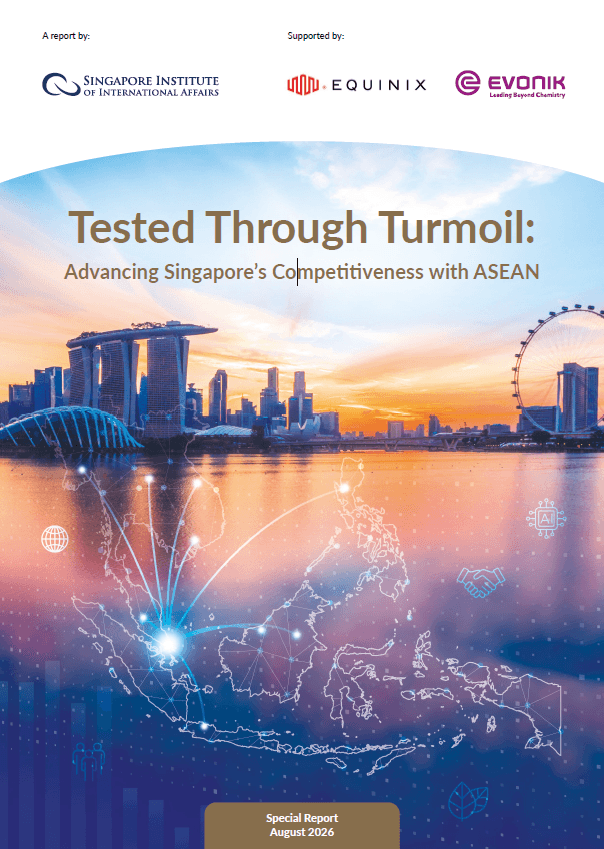
The report, titled, Tested Through Turmoil: Advancing Singapore’s Competitiveness with ASEAN, was launched at SIIA’s 18th ASEAN & Asia Forum. It examines how Singapore can remain competitive amid global uncertainty, geopolitical tensions, supply chain shifts, and climate pressures.
The report draws on SIIA’s analysis and a series of roundtables and discussions with representatives from multinational corporations, collectively comprising the SIIA Competitiveness Commission (CompCom). These discussions were convened in association with the government-led Economic Strategy Review (ESR), with insights from the CompCom discussions shared with the ESR’s Committee 1 on Global Competitiveness.
The report notes that Singapore has come through recent crises including the COVID-19 pandemic relatively well, due to strong institutions, good crisis management, fiscal reserves, and openness to trade and investment. A key dimension of Singapore’s resilience has also come from its international connections in finance, shipping, aviation, and supply chains.
However, the report cautions that Singapore’s future competitiveness cannot be taken for granted as global uncertainty and competition intensify.
Mr Simon Tay, Chairman of SIIA and director of the report, said:
“This report underlines a simple but important point: A stronger ASEAN is good for Singapore. If our neighbours become more competitive, integrated, and resilient, Singapore will have more opportunities to play its role as a trusted hub and partner. The task ahead is to strengthen Singapore’s own capabilities while working with the region to form a competitive ecosystem.”
Mr Satya Ramamurthy, co-director of the report and Associate Council Member of SIIA, said:
“CompCom members continue to have great confidence in Singapore’s ability to leverage the opportunities and tackle the challenges posed by AI, job creation, and cost pressures. They also shared tangible ideas to further the competitiveness of Singapore and ASEAN, which are detailed in the report.”
Based on perspectives from the CompCom discussions, the report sets out 12 recommendations for Singapore’s competitiveness. These include strengthening engagement with MNCs on AI adoption, building apprenticeships and work-based learning, exploring regulatory frameworks for fractional employment, as well as measures to help businesses with cost pressures arising from the disruption of shipping via the Strait of Hormuz.
Dr Claus Rettig, President, Asia Pacific, Evonik (SEA) Pte Ltd, said recent disruptions have reinforced the importance of reliability as part of Singapore’s value proposition.
“The latest Middle East conflict interrupted again value chains and our production hub in Singapore demonstrated its reliability for our customers in Asia. Reliability is becoming more and more important as a competitive edge,” said Dr Rettig.
The report recommends that Singapore-based investors increase their understanding of the national policies of neighbouring economies, including their green and digital economy development plans. National competitiveness and regional competitiveness should not be seen as separate objectives, but mutually reinforcing ones.
Singapore’s future lies not only in attracting investment to Singapore itself, but in mobilising capital and partnerships in ASEAN and Asia. As ASEAN member states continue moving up the value chain, opportunities will emerge for higher-value activities like renewable energy development and AI data centres to be located in the region, including in the Johor-Singapore Special Economic Zone (JS-SEZ), Batam-Bintan-Karimun region, Sumatra, and in industrial parks with linkages to Singapore.
Ms Wendy Cheong, Managing Director and Regional Head of APAC, Moody’s Ratings said:
“Singapore’s standing as a trusted hub is underpinned by qualities that investors value — policy predictability and institutional credibility that continue to support confidence during periods of uncertainty. ASEAN’s deepening connectivity and resilience are part of the same story. A more competitive, better-connected ASEAN, and Singapore’s position as a regional and international finance centre, mutually contribute to the region’s continued growth and development. The two are not separate — they’re increasingly part of the same value proposition of resilience in a more complex global environment.”
This vision requires continued investment in capacity building, both in Singapore and across the region. From the Asian Financial Crisis, SARS, Global Financial Crisis, and COVID-19 pandemic, Singapore has consistently emerged stronger from crises by both enhancing its capabilities and strengthening its international connections. The recommendations in the report hope to contribute to ongoing discussions on how Singapore can continue building resilience and competitiveness, together with ASEAN and Asia, in an increasingly uncertain world.
The report was supported by Evonik and Equinix Singapore.
* * * * *
About the Tested Through Turmoil Report
The Tested Through Turmoil: Advancing Singapore’s competitiveness with ASEAN Report examines how Singapore can strengthen its competitiveness amid global uncertainty by deepening its links with ASEAN. The report draws on SIIA’s analysis and insights from roundtables with multinational corporations convened through the SIIA Competitiveness Commission (CompCom), which served as a knowledge parter to the Economic Strategic Review by contributing private sector perspectives on Singapore’s future.
Download the report here: https://siiaonline.org/special-report-tested-through-turmoil
About the Singapore Institute of International Affairs (SIIA)
Insights • Networks • Access
Established in 1962, the Singapore Institute of International Affairs (SIIA) is a not-for-profit and independent think tank committed to producing policy analysis, fostering in-depth dialogues and bridging gaps between policymakers, private sector decision-makers and experts to shape public policy and social responses. Centred around ASEAN-focused themes, the institute aims to deliver policy analysis in international affairs and on issues driving environmental sustainability. As a founding member of the ASEAN-ISIS (ASEAN Institutes of Strategic and International Studies) network since 1988, we engage in “Track II” diplomacy, fostering dialogue among stakeholders in our region and beyond. Visit us at www.siiaonline.org.