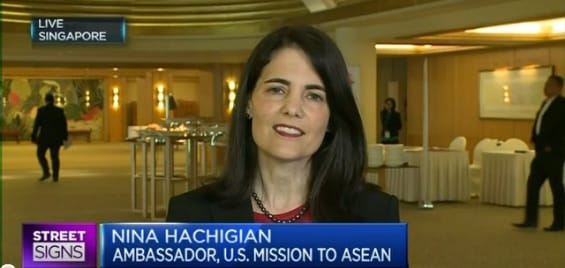
CNBC interviewed US Ambassador to ASEAN Nina Hachigian on the sidelines of the 8th ASEAN and Asia Forum (AAF), organised by the SIIA on 1 Oct 2015. The video is available on cnbc.com
TRANSCRIPT
Amb. Hachigian: I’ve seen actually some very positive progress on those sorts of issues here since I’ve been Ambassador. They’re negotiating now the ASEAN Economic Community that will be unveiled at the end of this year, and that is causing regulations to be passed in all ten of the ASEAN countries. And the United States, as the largest investor here, we have a large stake in this succeeding. So we’ve been helping in various ways. Just recently, in the Philippines, they’ve passed a competition law for the first time to comply with the ASEAN Economic Community tariff barriers. There’s lots of work left to do but there’s a real strong political will towards getting it done.
Q. I just want to explore the idea and the relationship between the US and the ASEAN members. Barack Obama has made it quite clear in his two presidencies the pivot towards Asia particularly in this region can foster closer ties. And yet there have certainly been some issues on what’s going on in the South China Sea, I know it’s a thorny issue, and I just want to flesh this out a bit. Philippines and Vietnam have brushed up against China, but they’ve been sort of lone voices out there and haven’t seen solidarity with other ASEAN members. Is the US disappointed that we haven’t seen a little bit more solidarity within ASEAN to tackle that issue?
Amb. Hachigian: I think there’s actually been great solidarity. If you look back at the April statement that the leaders of all ten ASEAN countries issued, they said they had serious concerns about land reclaimation in the South China Sea, and that they were concerned this might erode peace and stability and trust in the region, and that sentiment was again repeated in Kuala Lumpur by the foreign ministers, just in August. So I actually think ASEAN has shown a great deal of solidarity on this issue, and no, we’re not disppointed on that in the least. We’re really supporting ASEAN’s call for a non-violent and peaceful resolution to these disputes that supports international law.
Q. That is one side of the story, I mean, I guess you could say – this is a quote of yours, ‘no amount of sand can change sovereignty’. This is the ASEAN position on the South China Sea, but of course China has its own position and is continuing to build within that region, how do you get away from that, how do you go forward and find peace on this when there is no agreement with the biggest player in the region?
Amb. Hachigian: Sovereignty issues are notoriously difficult for countries to solve. But they have a process in place, ASEAN and China are negotiating a code of conduct, we want to see that expeditiously concluded. What we’ve called for is a halt to all further land reclamation, militarisation and large scale construction on features in the South China Sea. We think that is what will turn down the temperature and allow more room for negotiation.
Q. But the thing is China doesn’t really recognise the international maritime law, they say the whole South China Sea is theirs. Countries like Malaysia in particular have been very active in terms of oil and gas exploration in this region. How do you think China and countries like Malaysia are going to brush up against each other when that goal to assume entire sovereignty in that ocean gets towards Malaysia’s shores?
Amb. Hachigian: Well, China is a member of the United Nations Law of the Sea treaty, which is the operative law in this case, and they have often said they do respect its terms, we’ve called for them to put their claims in terms that would be recognised by that legal treaty. That’s what they need to do. That would bring a lot of clarity to the situation. We don’t recognise any claims over water in international law, only claims over land matter under international law.
Q. Ambassador, there’s another side to the story which you specifically have written about before, and that is the destruction of the marine environment in that region. If there is no agreement at this stage on the sovereignty of the South China Sea, how do you get agreement on how to control and how to regulate the marine destruction that is occuring over construction, overfishing, etcetra.
Amb. Hachigian: I wish I had a better answer for you. We’re trying, and ASEAN is trying, but it’s something that I’m really worried about. Because those islands, those coral reefs are really important habitats for fish that feed the entire region, not to mention other places like the United States. And I’m very concerned that if you add what’s going on with the reclamation, with climate change, with overfishing and illegal fishing, it’s a quite scary picture for food security. There are millions of people in Southeast Asia that rely first on jobs as fishers, and on fish for their protein. That’s something I’m really concerned about, and we’re raising this at the highest levels.