Disruptions to flows through the Strait of Hormuz have shown how geopolitical tensions can reverberate beyond energy markets into transport, manufacturing, food supply chains and the wider economy. With peace efforts uncertain and disruptions continuing, how could the crisis affect Asia’s economic outlook beyond the energy market?
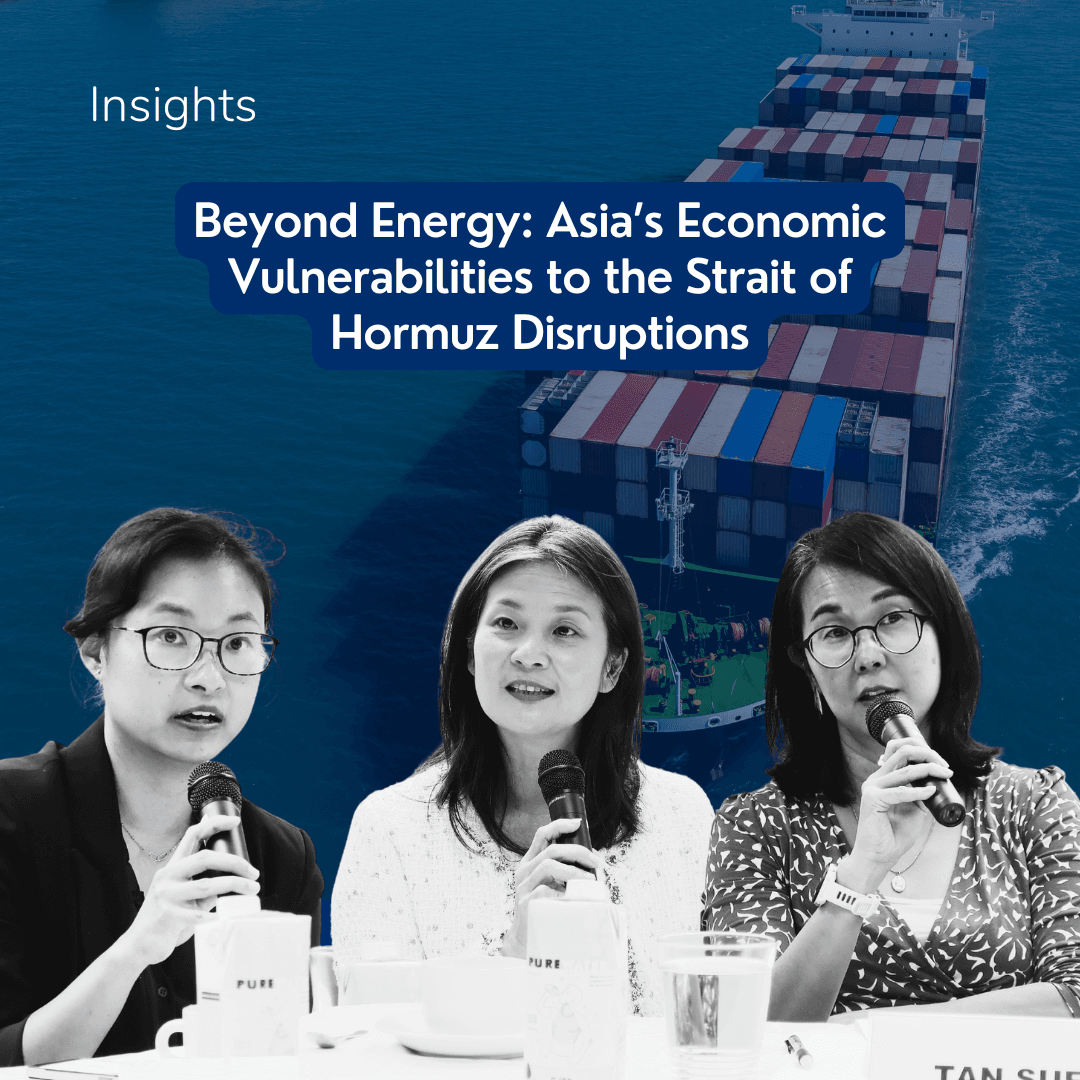
To examine this question, the SIIA held a talk on 22 July 2026 moderated by Ms. Quah Ley Hoon, Group Chief Corporate Officer of CapitaLand Investment and SIIA Council Member. The discussion featured Ms. Sue-Ern Tan, Head of the IEA Regional Cooperation Centre, and Ms. Denise Cheok, Head of Southeast Asia Economics at Moody’s Analytics.
This article is SIIA’s synthesis of the discussion. Points drawn from remarks by Ms. Tan (IEA) and Ms. Cheok (Moody’s Analytics) are expressly attributed to them; all other analysis and conclusions are SIIA’s.
Asia’s Resilience Thus Far
Ms. Cheok noted that Asian economies have proved more resilient than initially expected. Drawing on the energy shock of 2022 and the pandemic, Moody’s Analytics had anticipated a considerably larger impact on growth and inflation following the near-closure of the Strait.
She said inflation has instead remained relatively contained, noting that higher petrol and utility prices in Singapore have not yet translated into a major rise in food and retail prices. She added that inflation has increased modestly in the Philippines and Vietnam, but the broader Asian economy has held together better than expected.
Ms. Cheok attributed this partly to softer demand compared with 2022, reflecting tariffs and weakness in China’s domestic economy and property sector. She also noted that the oil market entered the crisis relatively well supplied.
Ms. Tan highlighted several further buffers: China reduced its crude-oil imports and drew on domestic stocks; IEA member countries agreed to release 400 million barrels of oil stocks; producers outside the Gulf increased exports; and Saudi Arabia and the UAE made greater use of alternative routes.
Both speakers nevertheless cautioned against assuming that the danger has passed. Ms. Tan described the near-closure as the largest energy-supply disruption on record, with cumulative oil-supply losses exceeding 1.3 billion barrels at the time of the discussion. She stressed that the most important step towards restoring stability remained the free and unimpeded opening of the Strait.
Risks Beyond Energy Markets
Asia remains particularly exposed. Ms. Tan noted that around 80 per cent of the oil and oil products transported through the Strait in 2025 were destined for Asia. She added that approximately 20 per cent of global LNG passes through the waterway, with around 90 per cent of that volume flowing to Asian markets.
The exposure extends beyond crude oil. Ms. Tan highlighted that the Strait also carries refined products such as diesel and jet fuel, as well as LNG and helium, which is important for medical equipment and semiconductors. Taken together, these dependencies could allow disruptions to spread through transport, shipping, manufacturing, chemicals, fertilisers, agriculture, and food supply chains.
Ms. Cheok cautioned that the risks are highly asymmetric. She explained that reopening the Strait would not immediately restore supply and that insurance and security risk premia would remain elevated. She warned that, by contrast, a prolonged closure, particularly if accompanied by further infrastructure damage, could lead to a much sharper rise in energy prices and severely weaken global growth.
Ms. Tan observed that alternative supplies may be available but will often travel farther and cost more. She stressed that affordability could therefore become as important as physical availability, with more vulnerable importers facing greater pressure than economies better able to absorb higher freight and energy costs.
Ms. Cheok identified unemployment, SME financing and defaults, and household debt stress as possible signs that the shock is spreading into the wider economy. For companies, this underscores the need to stress-test different durations of disruption and prepare for continued volatility in energy, transport, and insurance costs.
Both speakers also discussed how rising electricity demand from data centres and artificial intelligence. This could place further pressure on energy systems and shape future investment decisions.
Diversifying Asia’s Energy Options
Ms. Tan identified diversification, predictability and trust as central to energy security. She explained that diversification must cover not only suppliers but also transport routes and the sources that make up each country’s energy mix.
She also cautioned that diversification has limits: supplies brought in from farther away will cost more, and not all economies will be equally able to absorb the increase. She added that governments may therefore become more willing to pay a premium for reliable suppliers and routes.
The crisis may also reshape Asia’s energy mix, although not in a straight line towards cleaner energy. Ms. Cheok noted that countries may initially turn to readily available domestic resources, including coal. Ms. Tan similarly observed that coal is likely to retain a regional role, especially where it supports employment and domestic economic activity.
At the same time, Ms. Tan argued that the longer-term case for renewables is strengthening. She pointed to the falling costs of solar, wind and batteries, as well as the energy-security benefits of reducing dependence on fuels transported through vulnerable routes.
Ms. Cheok noted, however, that many competitively priced solar panels and clean-energy technologies are produced in China. Governments must therefore balance reduced fossil-fuel dependence against the risks of relying on another concentrated supply chain.
ASEAN: Turning Commitments into Projects
Asia’s resilience gives ASEAN a window to strengthen preparedness before existing buffers are tested further.
Ms. Tan noted that ASEAN already has mechanisms such as the ASEAN Petroleum Security Agreement (APSA) and the ASEAN Power Grid, but said the main challenge lies in implementation. She explained that operationalising APSA requires members to agree on how emergency assistance would be triggered and delivered. She also noted that the ASEAN Power Grid requires compatible regulations and physical infrastructure. Stable cross-border arrangements will also be needed to address financing, pricing, construction responsibilities, and risk allocation.
These uncertainties affect the bankability of regional projects. Ms. Tan noted that investors need confidence that projects will be completed and that political disputes will not interrupt energy flows. She suggested that successfully delivering one major cross-border project could establish an important precedent for subsequent initiatives.
Asia has weathered the initial shock better than expected, but resilience should not be mistaken for immunity. ASEAN’s priority should be to use this window to turn political commitments into operational arrangements and investable projects, while governments and businesses prepare for a more uncertain energy landscape.