After a turbulent year of raised and lowered tariffs, what lies ahead for US trade policy and what does this mean for ASEAN businesses?
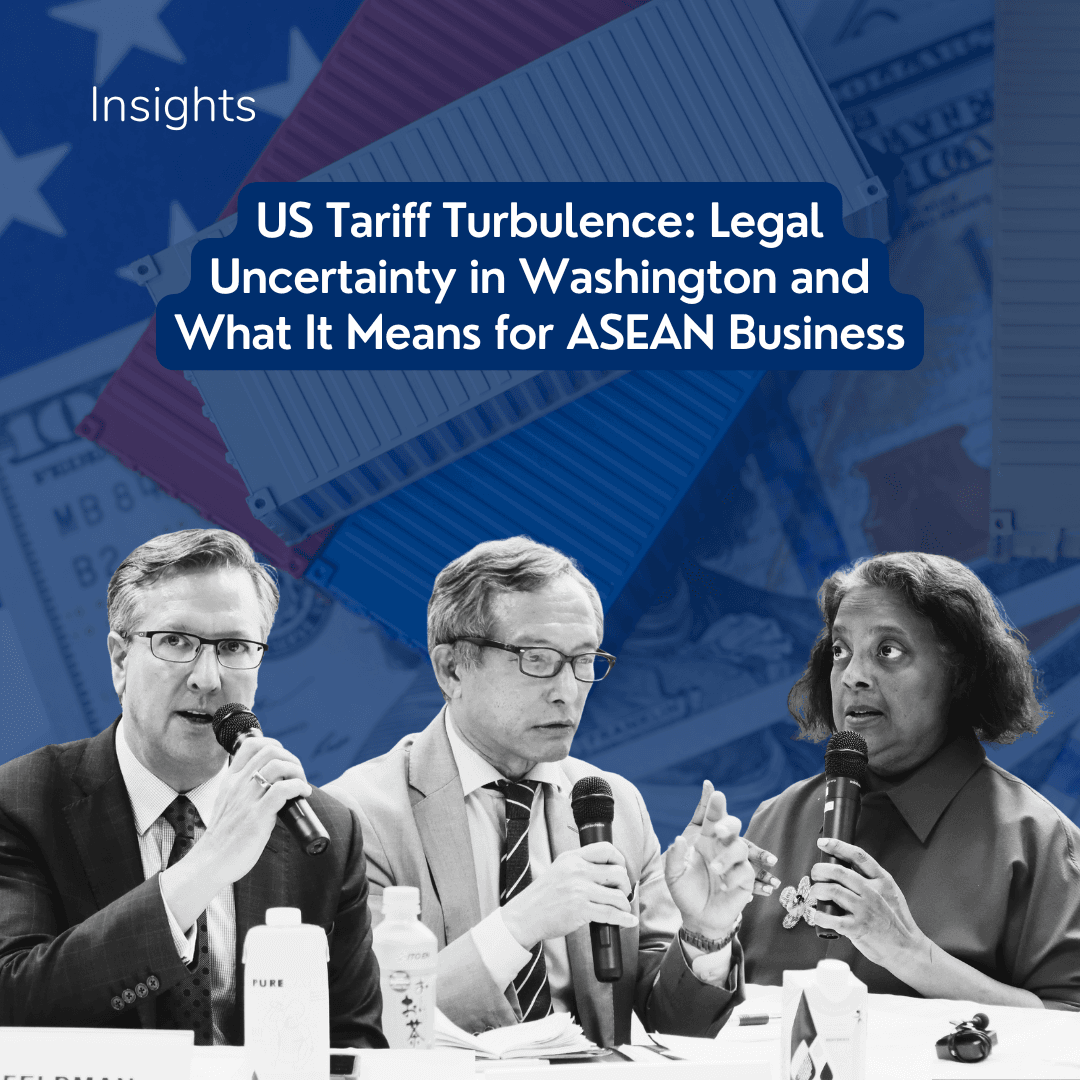
To examine these questions, on 22 June 2026, the SIIA held a talk on “US Tariff Turbulence: Legal Uncertainty in Washington and What It Means for ASEAN Business”, moderated by SIIA Chairman Mr. Simon Tay.
The talk featured perspectives from Mr. Alex Feldman, Partner at The Asia Group, and Ms. Elizabeth Chelliah, Principal Trade Consultant at the Centre for the Future of Trade and Investment, Singapore Business Federation. The discussion explored how legal setbacks have pushed the Trump administration towards other tariff mechanisms, and how ASEAN businesses should navigate a trade environment where uncertainty is becoming more structural.
Washington’s shifting tariff playbook
Mr. Feldman traced the importance of trade policy to President Trump’s first term. In the second Trump administration, trade again became an early priority. Mr. Feldman noted that one of the administration’s first actions was the America First Trade Policy memo, which instructed agencies to review US trade policy, protect American industry, and advance the administration’s trade agenda.
The major turning point came with the reciprocal tariffs announced on “Liberation Day” on 2 April 2025. Mr. Feldman described these tariffs as a means of bringing trading partners to the negotiating table.
However, legal challenges changed the terrain. In February 2026, the US Supreme Court ruled against the administration’s use of the International Emergency Economic Powers Act (IEEPA) to impose tariffs, meaning that tariffs imposed on that basis could no longer proceed. The administration first pivoted to using Section 122 of the US Trade Act, allowing the President to impose temporary tariffs of 10%, capped at 150 days. With the temporary tariffs due to expire in July 2026, the administration announced a new set of measures under Section 301, targeting 60 economies over alleged forced labour concerns, with separate investigations also focused on allegations of structural excess capacity.
Mr. Feldman noted that Section 301 had traditionally been used as a more targeted instrument but was now being applied more expansively. As he put it, “[Section] 301 was used as a blunt instrument instead of a surgical tool”. He also observed that the sequencing of policy action has shifted: rather than investigating, negotiating, and then imposing tariffs, the administration was increasingly using tariffs first to create leverage before pursuing investigations and negotiations.
While the tariffs imposed under IEEPA were eventually struck down, both speakers noted that Section 301 tariffs are structured in a way that makes them less susceptible to legal challenges. Ms. Chelliah added that forced labour is not simply a Republican issue, but a broader American concern, which may make such measures more durable regardless of future political developments in Washington.
Where does this leave ASEAN?
For many ASEAN businesses, the immediate concern is not only the level of tariffs, but the uncertainty surrounding them. As Ms. Chelliah said, “businesses thrive on certainty”, as they enter into forward contracts and supply chain arrangements based on expectations of stability.
Despite this uncertainty, Ms. Chelliah noted that many firms still see the US as a viable destination market, as profit margins are still sizeable. This means that businesses are not necessarily prepared to abandon the US market, even as the policy environment becomes more difficult.
At the same time, tariffs alone are unlikely to bring manufacturing back to the US in the short term. Ms. Chelliah argued that reshoring would require the right business climate, infrastructure, logistics, and cost conditions. Mr. Feldman made a similar point from the perspective of US companies, observing that “American companies are committed to China”. Many are not leaving China altogether, given China’s broader infrastructure that supports production there.
However, tariff differentials between China and other markets, particularly Vietnam and other parts of ASEAN, could shape where new investment flows. The region may benefit from trade diversion and supply chain diversification. But these opportunities will depend on how tariff differentials evolve.
ASEAN’s dilemma
For ASEAN, the tariff turbulence creates both opportunities and risks. Mr. Feldman noted that the current environment has accelerated trade diversification, including within ASEAN and with non-US partners. He also pointed to momentum behind other trade arrangements including RCEP and CPTPP.
On the other hand, ASEAN’s ability to respond collectively may be tested due to the different tariff rates faced by ASEAN economies. Ms. Chelliah said that ASEAN remains a grouping of separate member states, each with its own domestic priorities, even as it continues to speak of ASEAN centrality, solidarity, and an “ASEAN-first” approach. This tension is particularly visible in the Agreements of Reciprocal Trade (ART) that some member states have pursued individually with the US.
Ms. Chelliah noted that under the ASEAN Trade in Goods Agreement (ATIGA), member states are not supposed to give better treatment to non-ASEAN partners. If bilateral concessions to the US are implemented in ways that go beyond ASEAN commitments, this could test the coherence of ASEAN’s internal trade arrangements and complicate its ability to negotiate as an economic bloc.
What businesses should do
Essentially, both speakers advised businesses not to assume tariff measures will be short lived. The broader message is that businesses need to take greater ownership of trade risk. The old assumption of a largely tariff-free and rules-based trading system can no longer be taken for granted. ASEAN businesses need to be ready to navigate a trade environment where uncertainty itself has become a structural condition.
Ms. Chelliah recommended a combination of caution and advocacy in this environment. She noted that businesses need to proactively assess their own exposure, understand how tariff measures affect their supply chains, and provide feedback through their trade associations and governments. Businesses may also need to engage directly in Section 301 processes, including through submissions or appeals, rather than waiting for governments to act first. For firms that continue to engage in the US market, tariff risk will need to be factored into pricing, contracts, sourcing, and long-term investment decisions.