Media Release
For Immediate Release
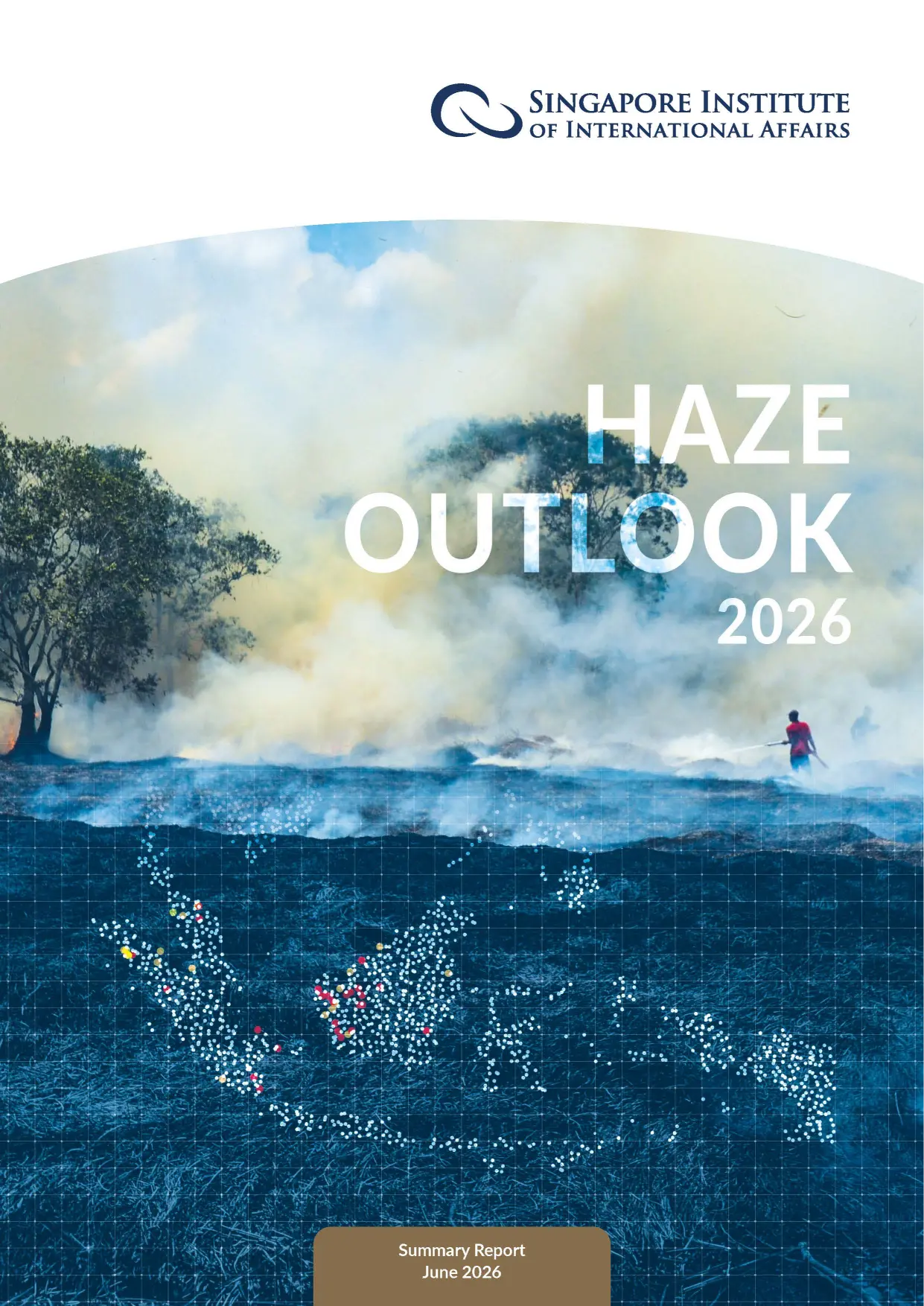
SIIA Haze Outlook 2026 Warns of High Risk of Severe Transboundary Haze Event
Convergence of El Niño, dry weather conditions, economic pressures and rising biofuel demand could test regional fire prevention efforts and ASEAN cooperation
The Singapore Institute of International Affairs (SIIA) today launched its Haze Outlook 2026 report, warning of a high risk (“Red”) of a severe transboundary haze incident affecting Brunei, Indonesia, Malaysia and Singapore in the remaining months of 2026. The report identifies August to September as the peak danger period, driven by the El Niño and Indian Ocean Dipole weather phenomena.
The report identifies a convergence of weather, policy and market factors that could heighten the risk of fires and haze across the region.
Key Findings
- Red risk rating for a severe transboundary haze incident in 2026
- El Niño and a possible positive Indian Ocean Dipole could bring hotter and drier conditions
- Fire prevention and land management efforts face a major stress test
- Rising demand for agricultural commodities and biofuels could increase land-use pressures
- ASEAN cooperation and sustainable land management will be critical to reducing risks
A Rare Red Risk Rating
This is only the second Red risk rating issued since the SIIA launched the Haze Outlook in 2019. The previous Red risk assessment was issued in 2023, a year that saw a return of significant haze incidents in the region.
Weather Raises Fire Risks
The report highlights growing concerns over the return of El Niño conditions in 2026 and the possibility of a stronger and more prolonged dry season. Some meteorologists have also warned of a potential positive Indian Ocean Dipole (IOD), which could further intensify hot and dry weather conditions and increase fire risks across Southeast Asia.
Policies: Stress Test for Preparedness
Beyond weather conditions, the report notes that governments, companies and communities face a significant stress test in maintaining fire prevention and sustainable land management efforts amid economic uncertainty and budget pressures. At the same time, rising demand for agricultural commodities and biofuels could place additional pressure on land-use sectors if not managed sustainably.
Mr. Simon Tay, Chairman of the SIIA, said: “The forecasts warn of a severe dry season, but we must not be fatalistic. There is much that can be done to prevent the worst and strengthen climate resilience, energy and food security, and regional cooperation.”
The haze is not simply an environmental problem. While preparedness has improved significantly since earlier haze crises, 2026 will be a major test of whether governments, businesses and communities can work together to prevent fires and protect livelihoods. “The challenge,” Mr. Tay said, “is to ensure that sustainable practices are maintained across entire supply chains, including by small and medium-sized enterprises that may be operating under tighter economic pressures.”
The report notes that Indonesia has strengthened its institutional response to forest and land fires, including establishing a new inter-agency Forest and Land Fire Coordination Desk and continuing efforts to improve monitoring, enforcement and community firefighting capabilities. Major companies have also expanded fire prevention measures and sustainability commitments in recent years.
“The main haze risk this year is from the weather. Historically, the most severe haze has occurred in years with both a strong El Niño and ‘positive’ IOD, like in 1997 and 2015” said Mr. Aaron Choo, Senior Assistant Director, Special Projects and Sustainability, SIIA. “The 1997 to 1998 haze caused US$9.3 billion (S$12 bn) in economic losses across Southeast Asia, while the 2015 haze resulted in some US$16.1 billion (S$20.6 bn) of losses in Indonesia alone. Policymakers and the private sector are aware of the need to prevent damage to ecosystems, and to avoid business closures and human health impacts.”
Markets: Economic Uncertainties Ahead
The SIIA cautions that severe weather conditions could still overwhelm existing prevention measures if vigilance lapses. The report also points to emerging risks from higher agricultural production costs and growing biofuel demand, which may increase incentives for unsustainable land clearing among some producers.
“It will take months for the fertilizer and fuel price shocks caused by the Strait of Hormuz disruptions to subside. Cash-rich industries like palm oil can bear the increased costs, but producers of food crops like fruit and vegetables are facing greater difficulties,” said Ms. Khor Yu-Leng, Associate Director, SIIA. “The fuel crisis is also driving demand for biofuels, with Southeast Asian countries increasing the percentage of vegetable oil in diesel at the pump. This trend will continue even if the US-Iran agreement holds, as countries now want energy independence.”
The Haze Outlook 2026 further argues that haze prevention should be viewed as part of a broader agenda of sustainable land management and climate adaptation. Recent fires in Johor and floods in Sumatra illustrate how land-use decisions can create wider environmental and economic vulnerabilities across the region.
Strengthening ASEAN Cooperation
The report calls for stronger ASEAN cooperation, effective implementation of existing commitments, increased funding for haze prevention and sustainable land management, and greater collaboration among governments, businesses, investors, philanthropies, NGOs and local communities. It highlights the role of the ASEAN Coordinating Centre for Transboundary Haze Pollution Control (ACC THPC), the ASEAN Specialised Meteorological Centre (ASMC), and growing private and philanthropic initiatives supporting sustainable land use in the region.
Mr. Simon Tay, Chairman of the SIIA, said: “ASEAN needs to take greater ownership of this challenge as the region enters a potentially severe dry season and faces the longer-term impacts of climate change. Supporting solutions with adequate funding will be critical.”
The Haze Outlook 2026 is the eighth edition of the SIIA’s annual assessment of haze risks in Southeast Asia. The report draws on research, stakeholder consultations and engagement with government agencies, businesses, NGOs and experts across the region.
Download the report here: https://siiaonline.org/report-haze-outlook-2026
About the Singapore Institute of International Affairs (SIIA)
Insights • Networks • Access
Established in 1962, the Singapore Institute of International Affairs (SIIA) is a not-for-profit and independent think tank committed to producing policy analysis, fostering in-depth dialogues and bridging gaps between policymakers, private sector decision-makers and experts to shape public policy and social responses. Centred around ASEAN-focused themes, the institute aims to deliver policy analysis in international affairs and on issues driving environmental sustainability. As a founding member of the ASEAN-ISIS (ASEAN Institutes of Strategic and International Studies) network since 1988, we engage in “Track II” diplomacy, fostering dialogue among stakeholders in our region and beyond.
About SIIA’s Sustainability Programme
Our Sustainability Programme began in 1997 when we organised Singapore’s first haze dialogue with the Singapore Environment Council on the critical haze problem. The programme has evolved to address a broader range of sustainability issues, including agribusiness and forestry supply chains as well as the leveraging of green finance to advance ASEAN’s climate action and carbon neutrality goals.