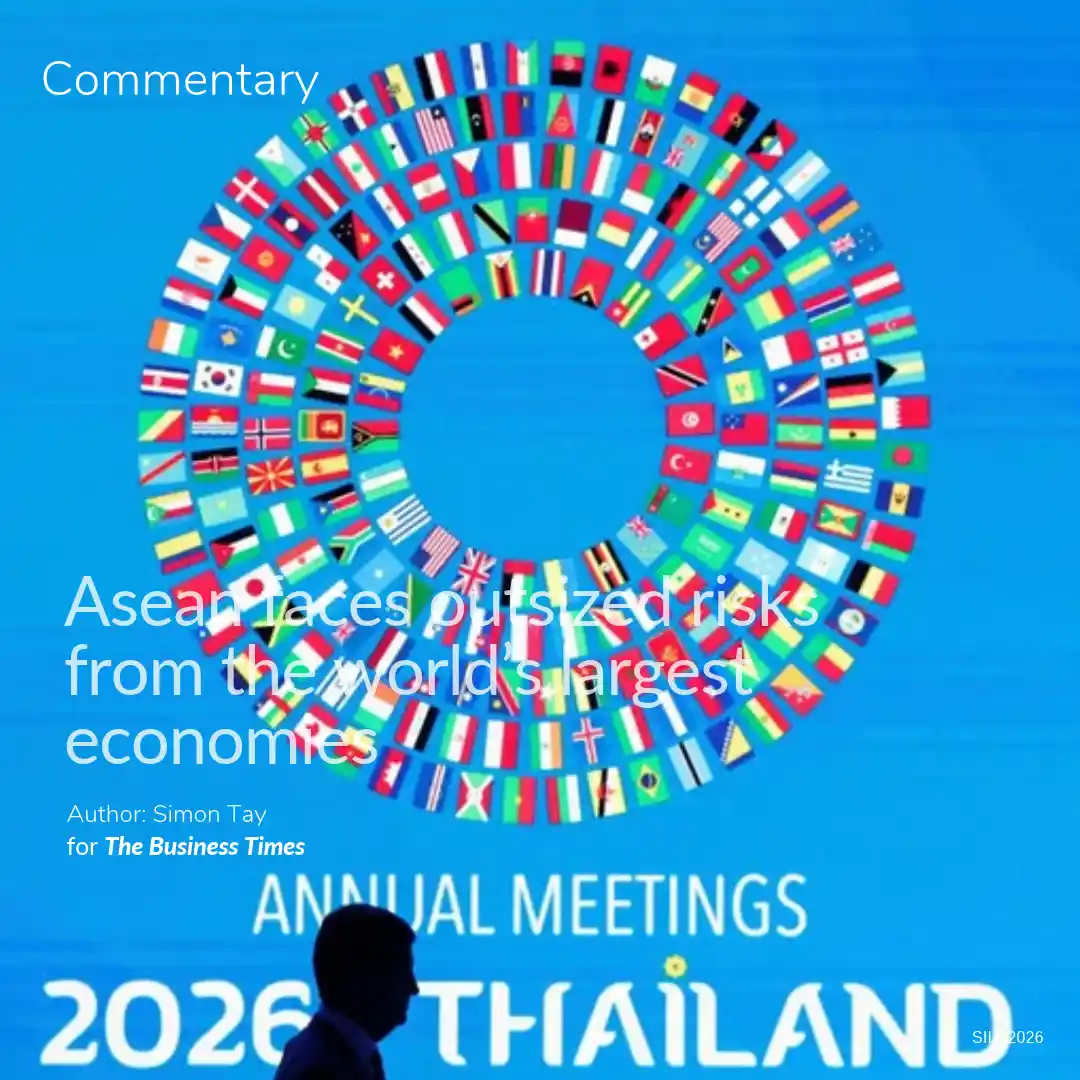
ASEAN economies are already contending with slower growth, rising debt and higher energy prices. In a new commentary for The Business Times, SIIA Chairman Simon Tay examines how financial risks emerging from the world’s largest economies could have outsized consequences for the region.
He highlights concerns ranging from high public debt in the US, Japan and parts of Europe to the scale of investment in artificial intelligence and the possibility of weaker growth in China. For ASEAN, these risks could translate into higher borrowing costs, capital outflows, currency pressures and weaker external demand, with different economies affected in different ways.
While national policies remain essential, Simon argues that ASEAN should strengthen its regional resilience. This could include greater regional stress-testing, closer coordination between the ASEAN+3 Macroeconomic Research Office and the IMF, better preparedness around the Chiang Mai Initiative Multilateralisation, and deeper financial integration through local-currency bond markets and regional payment systems.
Looking beyond these immediate risks, he writes that ASEAN would do well to adopt a “Minus-2 world” perspective: a geopolitical strategy of finding ways forward that do not rely on either the US or China to provide stability and leadership.
“That does not mean excluding either power or forming another exclusive bloc, but widening options through cooperation among its members as well as key partners in Asia.”
Read the full commentary: https://www.businesstimes.com.sg/opinion-features/asean-faces-outsized-risks-worlds-largest-economies